

Mega-Ray 70W Mercury Vapor UVB BulbLeopard & Crested Geckos, Corn Snakes, Anoles & Red-Footed Tortoises
$48.95
70-watt Mega-Ray mercury vapor UVB + heat bulb for leopard geckos, crested geckos, corn snakes, anoles and small tortoises — mount 6–12″ above the basking spot. Fits a standard 150 W ceramic clamp lamp.
🏆 Proven 10-Year Track Record– The original Mega-Ray design
📉 Slow UVB decay – independently measured at just 15% loss after a year (UV Guide UK)
☀️ Natural Sunlight Simulation – Prevents metabolic bone disease
✍ Self-Ballasted Design – No external ballast needed
🛡️ Magnesium Oxide Inner Coating – Mega-Ray’s translucent coating design
🇩🇪 Made in Germany – Free US shipping, 30-day returns on unopened bulbs, 6-month warranty
Satisfaction Guaranteed
- Free US Shipping
- Authentic Mega-Ray
- 6-Month Warranty
- 30-Day Returns (Unopened)
Why it costs $48.95
- The price is set by Mega-Ray, not by us. It is the same at every authorised seller, so there is no cheaper genuine bulb to find by shopping around. If you see one well below this, it is worth asking where it came from.
- Shipping is inside that number. US shipping is free and there is no handling fee. The price on this page is the price at checkout.
- Made in Germany, shipped from Mega-Ray’s US distributor. We are a small Tennessee store, not the manufacturer, and we do not pretend otherwise.
- We hold no inventory. Your bulb ships from the distributor’s current stock rather than off a shelf here, which is the only claim about freshness we can actually stand behind.
Compare all four Mega-Ray bulbs
Every Mega-Ray puts out the same UVB at its working distance. What differs is how far above the animal it has to sit. Measure from the bulb face to your reptile’s back, then pick the bulb whose range covers it. Not sure? Start with the wattage guide.
| 70WYou are viewing this one | 100W | 160W | 275WMost ordered | |
|---|---|---|---|---|
| Who it is for | Leopard and crested geckos, corn snakes, anoles, juvenile red-footed tortoises | Bearded dragons in 40-gallon enclosures, red-footed tortoises, basking turtles | Adult bearded dragons in 4×2×2 enclosures, monitors, iguanas, red-eared sliders | Zoos, breeders and tall enclosures. Not a consumer bulb |
| Working distance | 6–12″ | 12–20″ | 18–24″ | 30–48″ |
| Optimum distance | 8–10″ | 14–16″ | 20–22″ | 36–42″ |
| Closer than this is too close | 6″ | 12″ | 18″ | 30″ |
| Fixture required | Ceramic socket rated above 70 W | Ceramic socket rated above 100 W | Rated above 160 W. Most reptile clamp lamps stop at 150 W | Porcelain keyless lampholder rated above 275 W |
| Price | $48.95 | $48.95 | $48.95 | $51.95 |
Free US shipping on all four. Prices are set by the manufacturer, so nobody sells a genuine Mega-Ray for less.
Common questions about the 70W
Will the 70W fit my fixture?
It needs a ceramic socket. Ceramic socket rated above 70 W. Mega-Ray asks for a fixture rated above the bulb’s own wattage, and this is the single most common mistake we see — a standard reptile clamp lamp is usually rated to 150 W, which is not enough for the 160W or the 275W.
How far above the basking spot should it go?
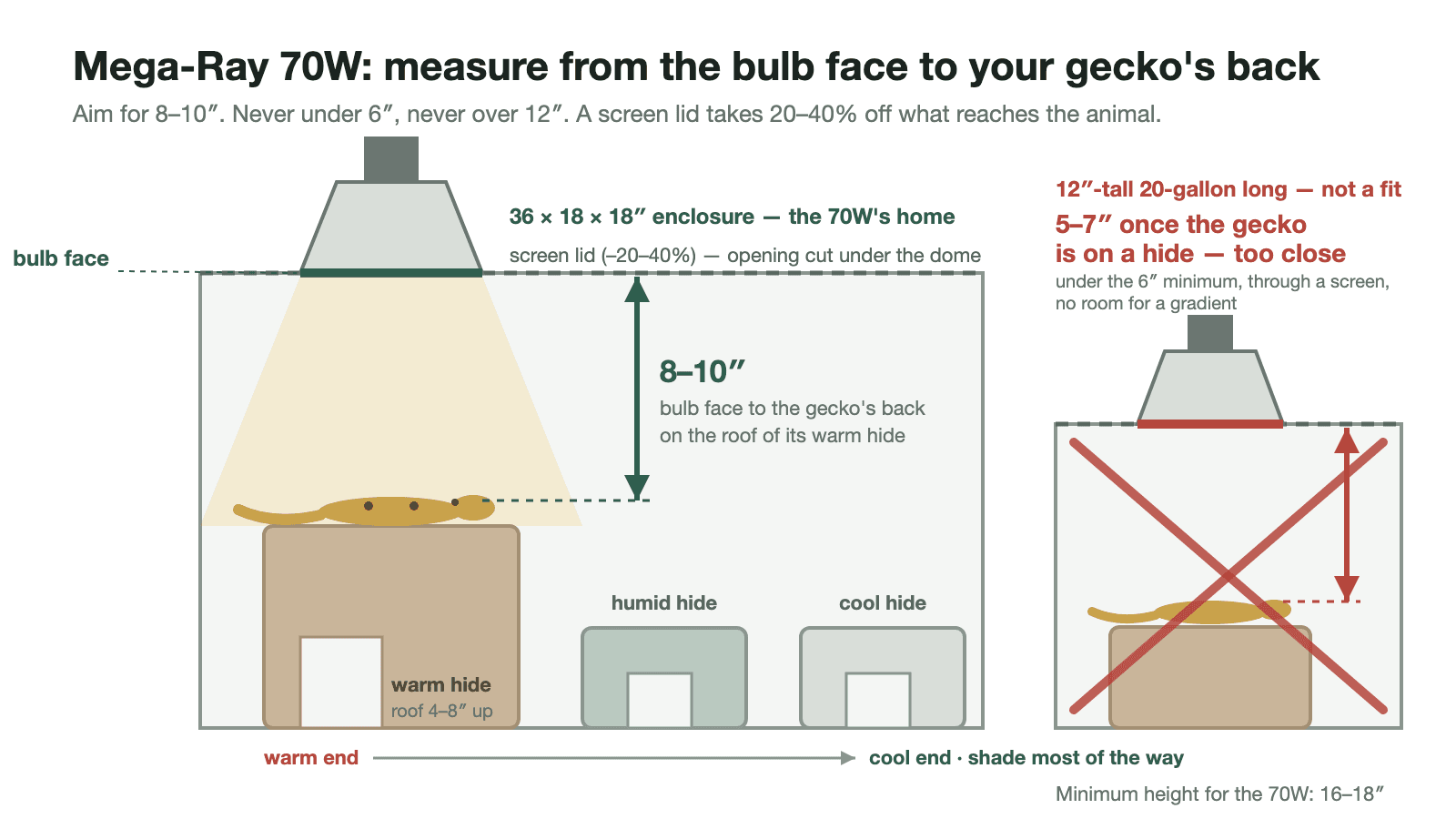
Measure from the bulb face to your reptile’s back, not to the floor. The 70W works between 6–12″, and 8–10″ is the sweet spot. A screen lid takes out roughly 20–40% of the UVB, so mount closer to the near end of the range if the bulb sits above screen.
Can you still buy mercury vapor bulbs?
Yes. The US Energy Policy Act of 2005 prohibited the manufacture and import of mercury vapor lamp ballasts after January 1, 2008, not the lamps themselves. Mega-Ray bulbs are self-ballasted, so they have no separate ballast and were never covered. More on how self-ballasted bulbs work.
How long does it last?
Plan on replacing it every 12 months. UV Guide UK measured a self-ballasted Mega-Ray at about 15% UVB loss after a year and 17% after 18 months, which is slow for this lamp type, but output does fall steadily and a bulb can fail without warning. See the independent measurements.
What are the downsides of a mercury vapor bulb?
It produces heat and UVB together from one socket, so you cannot adjust them separately — and you cannot run it on a dimmer or a pulse-proportional thermostat, which will destroy it. It also needs the mounting distance above to be right, because you cannot turn the UVB down. In a tall or wide enclosure that single-point output is an advantage; in a very small one it is not.
Is it safe to use over my reptile?
At the distances above, yes. The 2014 independent test found no UVC at all and confirmed the glass blocks wavelengths below 295 nm. The risk with any mercury vapor bulb is mounting it too close, which is why the minimum distance on this page is a hard floor rather than a suggestion.
Still not sure? Email us and we answer within one business day.
Description
Description
✅ This is the right bulb if you keep a leopard gecko, crested gecko, corn snake or anole — or a red-footed tortoise, skink or Chinese water dragon in a smaller enclosure — and the bulb face will sit 6–12″ above your animal’s back (8–10″ is ideal). It fits a standard 150 W ceramic clamp lamp. Free US shipping, 30-day returns on unopened bulbs, 6-month warranty.
Is the 70W the right bulb for you?
The 70W is the short-distance bulb. Its whole useful range sits between 6″ and 12″ from the animal’s back, which is shorter than many lamp stands put a bulb — so measure before you buy rather than after. It suits shade dwellers and smaller enclosures: animals that want a modest, well-defined patch of UV rather than an open-sun basking site.
| Bulb face to the animal’s back | UVB at that distance | Verdict |
|---|---|---|
| Under 6″ | Above the intended range | Too close — raise the lamp |
| 6–12″ | ~150–200 µW/cm² at the near end, 50–70 at the far end | The 70W’s working range |
| 8–10″ | — | Optimum |
| Over 12″ | Below useful UVB | Step up to the 100W |
Animals: corn snakes, leopard geckos, crested geckos and anoles (Mega-Ray’s “shade dweller” group); red-footed tortoises, skinks and Chinese water dragons sit in the 70–100W band, so measure and let the distance decide.
Fixture: a ceramic socket rated above 70 watts — Mega-Ray requires a fixture rated for more wattage and voltage than the bulb. A standard 150W reptile clamp lamp is adequate for the 70W provided the socket is ceramic.
Screen tops: a mesh lid removes 20–40% of the light, heat and UVB passing through it. With only 12″ of range to work with, that matters more on the 70W than on any other bulb — mount the lamp over an opening where you can.
Not sure this is the right wattage? See which Mega-Ray bulb your reptile needs →
Keeping a leopard gecko? Read the leopard gecko UVB and heat guide → — whether it needs UVB at all, 8–10″ from the bulb face to its back, and which enclosures the 70W fits.
New to mercury vapor bulbs? Read how they work, which wattage and how far away → — the self-ballasted design, the full distance table for all four bulbs, fixture rules and what independent testing measured.
📉 Independently tested
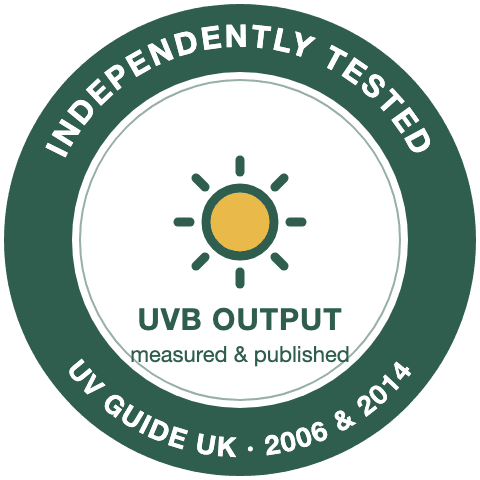
UV Guide UK measured a self-ballasted Mega-Ray at −15% UVB after one year and −17% after 18 months of daily use, where other mercury vapor lamps in the same test series lost 60–70% in their first 100 hours. The glass blocks everything below 295 nm — no UVC — and the inner coating throws a wider beam than a standard PAR38. (F. Baines, UV Guide UK, 2006 and 2014.) We still recommend replacing every 6–12 months, or when your Solarmeter says so.
In the BIAZA UV-Tool (Baines et al., Journal of Zoo and Aquarium Research, 2016 — a peer-reviewed assessment of 24 reptile lamps co-authored by Chester Zoo, Marwell, ZSL, Durrell and Bristol Zoo), the Mega-Ray 100W and 160W are rated as able to provide a suitable UV Index for all four Ferguson zones, one of only five lamps in the table to do so. Read the paper. See every measurement, the methods and their limits, on our test-results page.
🔬 Technical Specifications
| Wattage | 70 Watts |
|---|---|
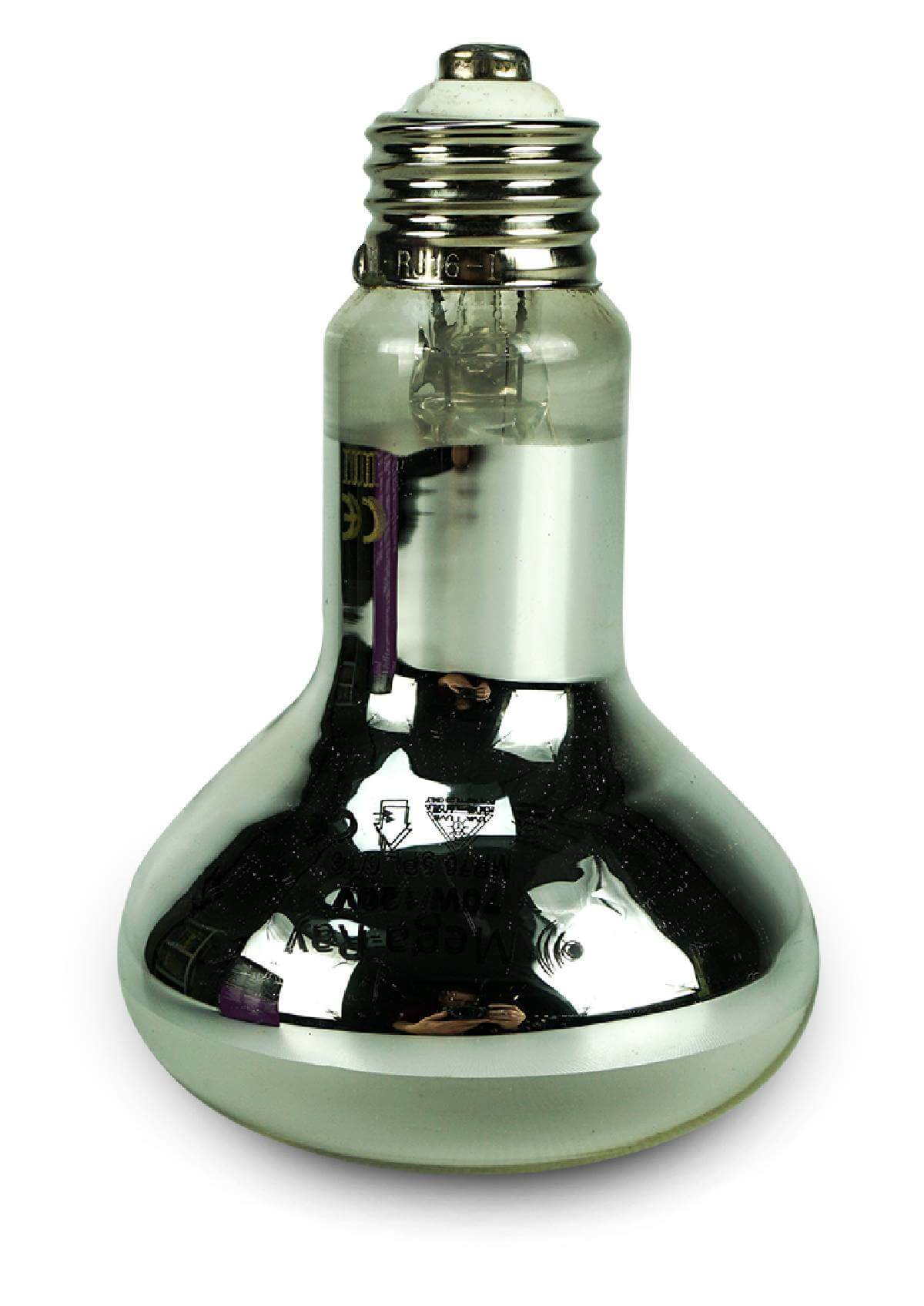
| Bulb Type | Self-Ballasted PAR-38 Narrow Flood |
| Working Distance | 6–12″ from the bulb face to the animal’s back (optimum 8–10″) — see the distance table above |
| Minimum Distance | 6″ from the animal’s back — never closer |
| Recommended Replacement | Every 6-12 months |
| Suitable For | 🦎 Shade dwellers: (i.e. corn snakes, leopard/crested geckos, burmese pythons, anoles) |
| Voltage | 120V (North America) |
Important Safety Information
- Must use wire dome fixture only – Plastic fixtures can melt
- Never closer than 6″ to the animal’s back — optimum 8–10″ (see the distance table above)
- Allow 15 minutes cool-down before moving if accidentally bumped
- Use with Solarmeter 6.5 for optimal UVB monitoring (recommended)
DISTANCE
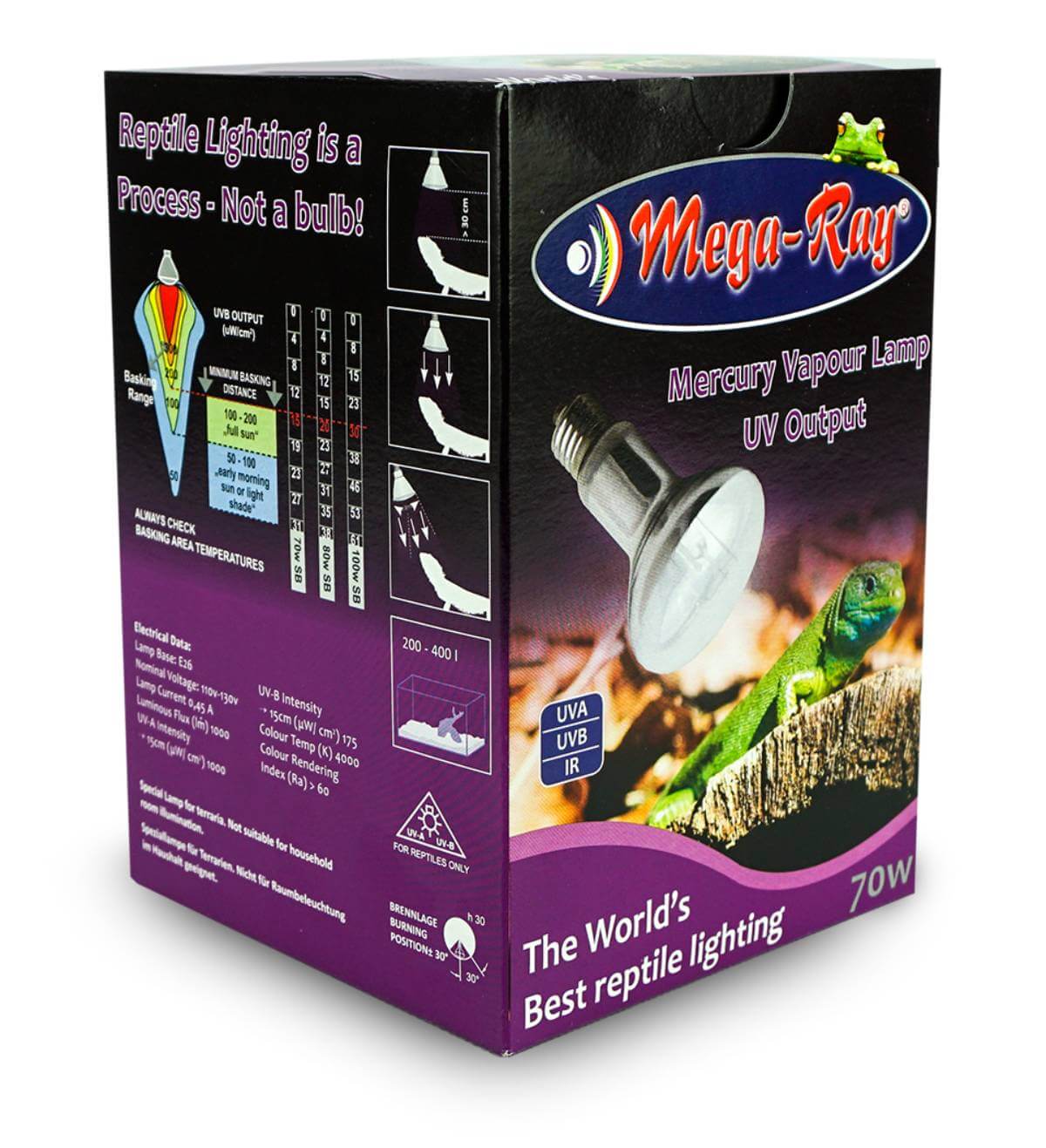
70 watt: MINIMUM : distance of 6” will produce approximately 150-200 microwatts per square centimeter (uW/cm2) of UVB and 900-1200 uW/cm2 of UVA. MAXIMUM: distance setting of 12” will produce 50-70 microwatts uW/cm2 of UVB. OPTIMUM: distance: 8-10”.
The MegaRay Mercury Vapor Self Ballasted Bulbs are professional bulbs and should be respected as such. All too often our clients mistake “minimum distance” with “optimum distance”. As an example, the 100 watt bulb can be used between 12-20” (3050 cm) but 14-16” seems to suite most species of reptiles (including turtles and tortoises). Screens will deflect 20-40% of the light, heat (infrared) and UVB.
HUSBANDRY
Vegetations creating spotted sunlight are another consideration of distance. Know your species. Do research. Always consider more distance and additional heat, as needed, along with proper humidity and airflow. Basking distance is measured from the lamp face to the basking distance or the reptile for optimum UVB and heat. If the husbandry is set up PROPERLY, ALL animals can use our bulbs.
FIXTURES
All of our bulbs require a ceramic base and require a higher amount of wattage and voltage than the bulb you need. An example: you need a 100 watt 120 volt bulb, the fixture needs to hold over 100 watts for the best results.



Reviews
There are no reviews yet.