Do Leopard Geckos Need UVB? (And What Heat Lamp They Actually Need)
Short answer: a leopard gecko can live without UVB — but it does better with a little. The species is a crepuscular shade-dweller, Ferguson zone 1 in the peer-reviewed BIAZA UV-Tool, and zone 1 means low-level UV over part of the enclosure with deep shade to retreat into, not a sun-basking spot. What a leopard gecko cannot do without is heat: a warm surface of about 32 °C (90 °F) at one end and a cooler end to move to.
A Mega-Ray 70W does both jobs from one socket — in an enclosure tall enough to hold it at the right distance. Here is the number that decides it:
| Bulb face to the gecko’s back | Verdict |
|---|---|
| Under 6″ | Too close — raise the lamp |
| 6–12″ | The 70W’s working range — Mega-Ray’s figures: ~150–200 µW/cm² UVB at the near end, 50–70 at the far end |
| 8–10″ | Mega-Ray’s optimum. For a leopard gecko, aim for the 10″ end |
| Over 12″ | Below useful UVB — the bulb is lighting the tank, not the gecko |
If your enclosure cannot put the bulb face 8–12″ above the spot where your gecko will sit, with shade at the other end, a Mega-Ray is not the right fit — and we say so below.
The honest answer on UVB
Three facts, all from the UV-Tool paper (Baines et al., Journal of Zoo and Aquarium Research, 2016), the guide UK zoos use to choose reptile UV lighting:
- Not strictly required. Vitamin D-deprived leopard geckos appear to absorb enough dietary calcium passively to avoid metabolic bone disease (the paper cites Allen et al. 1996) — which is why geckos raised on dusted insects and no UVB can be healthy.
- Beneficial all the same. Leopard geckos exposed to low-level UVB made their own vitamin D3 — blood levels 3.2 times higher than geckos on dietary supplement alone (Wangen et al. 2013, as cited).
- Low-level means low. Zone 1 — “crepuscular or shade dweller, thermal conformer” — averages UVI 0–0.7 in the wild, with a recorded maximum of 0.6–1.4. A bearded dragon, zone 3, averages 1.0–2.6 and has been recorded at 7.4.
The paper’s conclusion on nocturnal and crepuscular animals: “there would seem to be no reason to withhold provision of full spectrum lighting, provided that they are able to spend the daylight hours in an appropriate retreat, with access to a UV-B component suitable for a shade-dwelling or crepuscular species (i.e. Ferguson zone 1).”
Optional, beneficial, low, and only with hides — the standard this page holds a Mega-Ray to.
Heat is not optional
The UV-Tool’s entry for Eublepharis macularius: basking-zone surface 32 °C (90 °F); daytime air 25–29 °C (77–84 °F); night air 20–24 °C (68–75 °F); 14 hours of light to 10 of dark; a winter cooling period; microhabitat “rocks, crevices or burrows” in desert and dry shrubland.
That is a desert animal that spends the day under a warm rock rather than on top of it and comes out around dusk. So the “leopard gecko heat lamp” question and the UVB question are the same question. A Mega-Ray 70W is a heat lamp — a self-ballasted mercury vapor bulb runs hot — that also produces UVB. One socket, one warm end, one gradient.
Why the 70W, and why the distance is everything
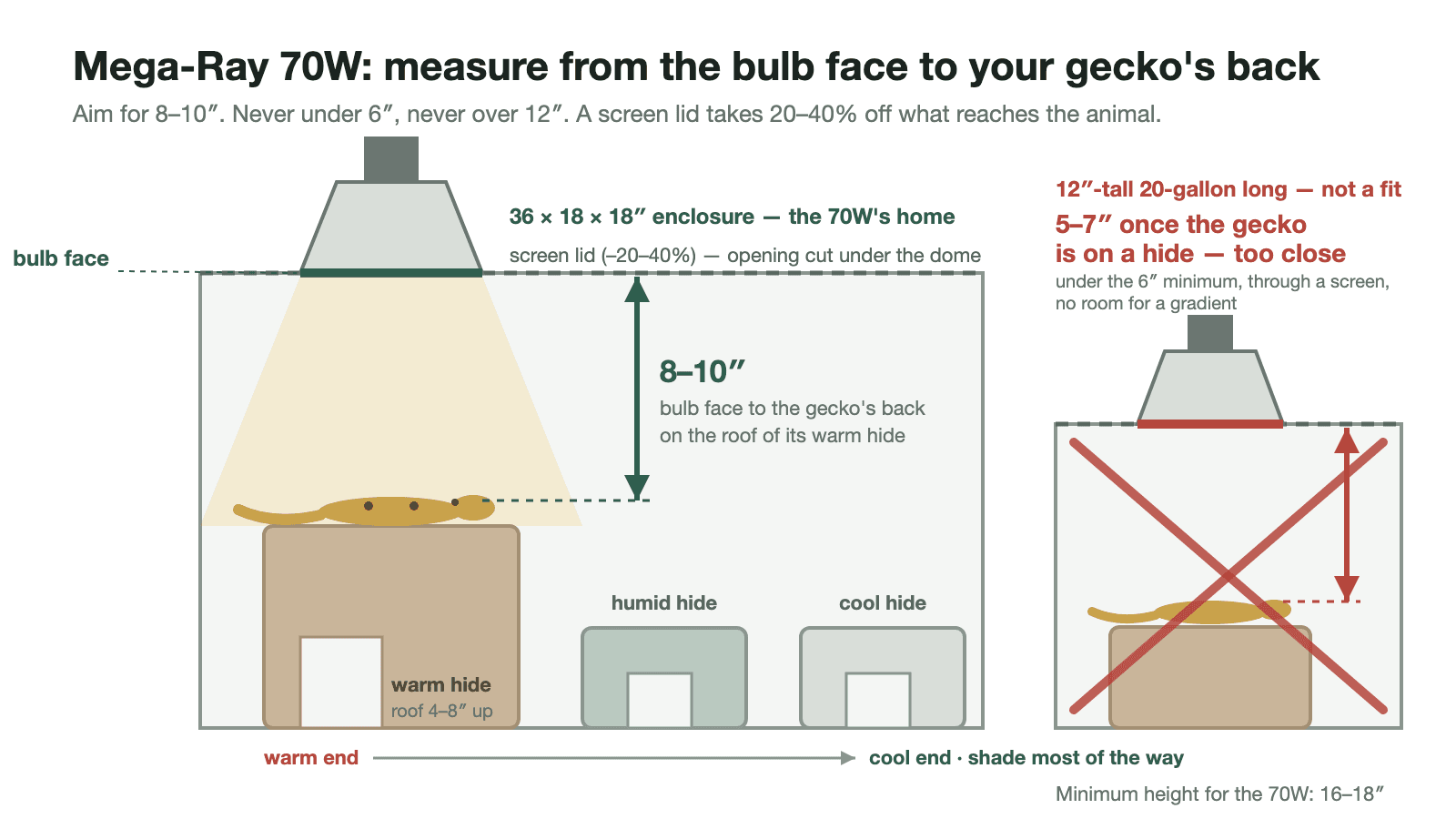
Mega-Ray puts leopard geckos in its “shade dweller” group with corn snakes, crested geckos and anoles, and maps that group to the 70W: minimum 6″, maximum 12″, optimum 8–10″, bulb face to the animal’s back.
Mega-Ray’s own warning: “All too often our clients mistake ‘minimum distance’ with ‘optimum distance’.” For a shade-dweller it counts double. Aim for 10″, the far end of the optimum, and treat 8″ as the floor.
With a UV index meter, aim for the zone 1 band — no more than about UVI 0.6–1.4 at the closest point the gecko can reach, zero inside the hides — by moving the lamp within 8–12″. If it is still above 1.4 at 12″, the bulb is more than that enclosure can use.
Measure from the bulb face to the gecko’s back, not the floor
Put the warm-side hide and its flat rock where they will live, then measure from the glass face of the bulb to the top of the rock, plus an inch for the gecko standing on it. Three things change that number:
- A screen lid takes 20–40% of the UVB and heat (Mega-Ray’s figure) — with 12″ of range, that matters more on the 70W than on any other bulb. Mount over an opening where you can; if the lamp must sit on mesh, stay at the 8–10″ end, never under 8″.
- Glass or plastic between bulb and gecko blocks UVB entirely. The UV-Tool: ordinary glass and plastics “normally block transmission of all UV-B.” Through a glass lid it is a heat lamp only.
- The lamp points straight down, above the animal, so the head and brow ridge shade the eyes (the UV-Tool’s reason).
Which enclosures the 70W fits — and which it does not
12″ tall — a 20-gallon long, a 10-gallon. Not a fit. A dome on the lid puts the bulb face about 11″ above the floor; the moment the gecko climbs onto a hide it is 5–7″ from the glass — under the minimum, through a screen, with no room for a gradient. We will not sell you a 70W for this tank, and we have no other bulb that changes the geometry.
16–18″ tall — a 40-gallon breeder (36×18×16), a 36×18×18. The enclosure the 70W is for. Lamp over one end; a flat rock or a flat-roofed hide 4–8″ off the floor under it, so the gecko’s back sits 8–10″ below the bulb face; cool and humid hides at the other end.
24″ and taller — a 4×2×2, a front-opening cabinet. Only if the warm spot can be brought to within 8–12″ of the bulb face: a stacked-rock ledge, a hide with a roof at that height, or the fixture hung inside on a guarded ceramic socket. A bulb 20″ from a ground-dwelling gecko is not delivering UVB. If none of that is possible, tell us the dimensions before you buy anything.
Hides and shade are part of the bulb
The UV-Tool: “Provision of shade is vital for all species, regardless of their Ferguson zone.” For a zone 1 animal the shade is most of the enclosure — warm hide at the lamp end, cool hide at the far end, humid hide between, and enough cover to cross without walking under the beam. A gecko with nowhere dark to go is not regulating anything.
Albino and hypomelanistic animals need extra care: the UV-Tool warns they let far more UV through skin and eyes and “are therefore likely to need much reduced exposure levels.” Many leopard gecko morphs are exactly that. For an albino, sit the bulb at the 12″ end, add cover, watch how it behaves — or ask us first.
Fixture, timer, and the things that end a bulb early
- A ceramic socket rated above the bulb’s wattage — Mega-Ray requires a fixture rated for more wattage and voltage than the bulb. A standard 150 W ceramic-socket clamp lamp fits the 70W.
- On a plain timer, 14 hours on, 10 off — the UV-Tool’s photoperiod for the species. Dark at night.
- Never on a dimmer or dimming thermostat. A self-ballasted mercury vapor bulb is on or off; chopping its supply stops the arc and shortens its life. Control the warm spot with distance and ventilation.
- Out of reach — the UV-Tool: “All bulbs should be inaccessible to the animals; wire guards may be necessary.”
- Keep water off the hot glass — mist the humid hide with the lamp off.
- Write the install date on the base and plan on a new bulb every 6–12 months; it makes light and heat long after its UVB has fallen off.
Why a Mega-Ray
- Heat and UVB from one socket — for a species whose real need is a warm end with a little UV over it, the simplest correct setup there is.
- Independently tested. UV Guide UK measured a self-ballasted Mega-Ray at −15% UVB after a year and −17% after 18 months of daily use, where other mercury vapor lamps in the same series lost 60–70% in their first 100 hours (2006 report); a 2014 re-test found no UVC and glass that blocks everything below 295 nm. The lamps tested were the 100W and 160W — the 70W shares the self-ballasted design but has not itself been independently tested. Full results and their limits: our test results page.
- Made in Germany, shipped from Mega-Ray’s US distributor. Free US shipping, 30-day returns on unopened bulbs, 6-month warranty.
Common questions
Do leopard geckos need UVB to survive? No. The UV-Tool notes that vitamin D-deprived geckos can still absorb enough dietary calcium to avoid metabolic bone disease. Low-level UVB is beneficial rather than essential — 3.2 times the vitamin D3 in the study it cites.
What watt UVB bulb does a leopard gecko need? With a Mega-Ray, the 70W, bulb face 8–12″ from the gecko’s back, 10″ the target. Nothing bigger — a leopard gecko is a zone 1 animal.
How far should a heat lamp be from a leopard gecko? For the Mega-Ray 70W, 8–10″ to the gecko’s back on its warm rock; never under 6″, never over 12″. Allow for a screen lid (20–40% loss) by staying at the near end, not by going under it.
Can a leopard gecko get too much UVB? Yes — its recorded wild maximum is about UVI 1.4. A gecko that stops coming out at dusk, keeps its eyes shut under the lamp or hides at the cool end all day is telling you the lamp is too close or the shade too thin. Albino morphs are the most sensitive.
Will the 70W work on a 20-gallon long? No. At 12″ tall it cannot hold the bulb 8″ from a gecko on a hide. 16–18″ is the minimum for this bulb.
Do leopard geckos need a heat lamp at night? No — the Mega-Ray goes off at night. The UV-Tool lists night air at 20–24 °C (68–75 °F) in summer, which most rooms hold with no equipment. If yours runs colder, contact us before buying.
Choosing yours
- 16–18″ enclosure, warm rock 8–10″ under the bulb face → Mega-Ray 70W mercury vapor bulb — $48.95, made in Germany, free US shipping, 6-month warranty.
- Taller, shorter, or a screen and glass lid in the way → tell us the enclosure and we will give you a distance or tell you a Mega-Ray is not the right fit.
- A different species → the which bulb guide, or the mercury vapor explainer for how the bulb works.
Sources
- Baines, F., Chattell, J., Dale, J., Garrick, D., Gill, I., Goetz, M., Skelton, T. & Swatman, M. (2016). How much UV-B does my reptile need? The UV-Tool, a guide to the selection of UV lighting for reptiles and amphibians in captivity. Journal of Zoo and Aquarium Research 4(1): 42–63 — https://www.jzar.org/jzar/article/view/150. Table 1 (Ferguson zones: zone 1 UVI 0–0.7, maximum 0.6–1.4; zone 3 1.0–2.6, maximum 2.9–7.4); species database (Eublepharis macularius: zone 1, basking-zone surface 32 °C, day air 25–29 °C, night air 20–24 °C, photoperiod 14:10, winter cooling, microhabitat “rocks, crevices or burrows”, biome “deserts and xeric shrublands”); text on nocturnal and crepuscular species (Wangen et al. 2013, 3.2× 25-hydroxyvitamin D3; Allen et al. 1996); hypopigmentation; general cautions (shade, lamp position, guards, glass and plastics); Table 2 (Mega-Ray 100W and 160W rated for all four zones).
- Mega-Ray Pet Care Lighting, official distance and species guidance letter (70W: minimum 6″, maximum 12″, optimum 8–10″; ~150–200 µW/cm² UVB at minimum, 50–70 at maximum; screens deflect 20–40%; ceramic fixture rated above the bulb’s wattage; shade-dweller group). Reproduced on our species guide.
- UV Guide UK (2006). ReptileUV Mega-Ray Mercury Vapour Lamps for Reptiles — Test Report (archived copy) — a self-ballasted lamp at −15% UVB after 12 months and −17% after 18 months (280 → 240 → 233 µW/cm² at 12″); other mercury vapour brands in the same series −60–70% in their first 100 hours. Lamps on test: 100W and 160W self-ballasted.
- UV Guide UK (2014). Mega-Ray 100W and 160W test results (reproduced on ourreptileforum, `nofollow ugc`) — no UVC, glass blocks below 295 nm; lamps tested: 100W and 160W.
Already have a Mega-Ray?
We'll email you once when it's due for replacement, 11 months after you fitted it. One email, nothing else.