Mercury Vapor Bulbs for Reptiles: How They Work, Which Wattage, and How Far Away
A mercury vapor bulb gives a reptile heat, visible light, UVA and UVB from a single screw-in socket. For a basking species that is the whole lighting setup in one lamp. The part that decides whether it works is not the wattage on the box — it is how far the bulb sits above the animal’s back.
Measure that distance first, then pick the bulb:
| Bulb face to the animal’s back | Bulb | Optimum |
|---|---|---|
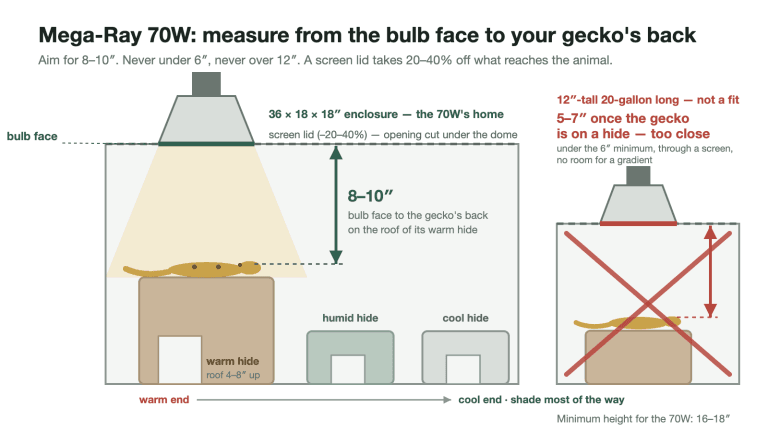
| 6–12″ | Mega-Ray 70W mercury vapor bulb | 8–10″ |
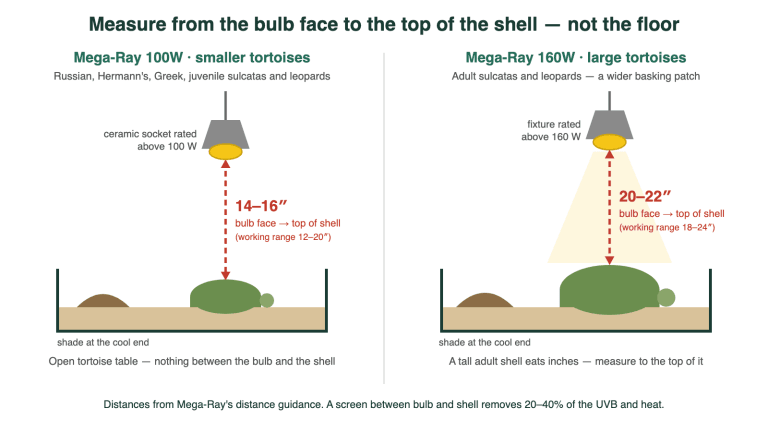
| 12–20″ | Mega-Ray 100W mercury vapor bulb | 14–16″ |
| 18–24″ | Mega-Ray 160W mercury vapor bulb | 20–22″ |
| 30–48″ | Mega-Ray 275W mercury vapor bulb — professional and zoo installations only | 36–42″ |
If your measurement falls between two bulbs, take the one whose optimum is closest. If it falls below 6″, do not buy a smaller bulb — raise the lamp. The rest of this guide explains why that one number carries so much weight.

What a mercury vapor bulb actually is
Inside the outer glass there is a small sealed arc tube. When you switch the lamp on, current arcs through mercury vapour inside that tube and the vapour emits light across a wide span of the spectrum — visible light, UVA, and the UVB that a reptile needs in order to make vitamin D3 and use the calcium in its food. The outer envelope runs hot, so the same lamp is also the basking heat source.
“Self-ballasted” is the part that matters for a keeper. Any arc lamp needs something to limit the current, or it draws more and more until it destroys itself. Industrial mercury vapor fixtures do that with a separate ballast — a heavy box wired into the luminaire. A self-ballasted lamp puts a tungsten filament inside the bulb instead, in series with the arc tube, and that filament does the same job. There is nothing to wire and nothing to buy alongside it: the bulb screws into an ordinary socket the way a household bulb does.
Two practical consequences follow from that design, and both surprise people:
- It takes a few minutes to reach full output. Heat arrives almost at once, from the filament. The arc tube warms up more slowly, and UVB climbs for several minutes after switch-on. A bulb that has been on for thirty seconds is not doing its job yet.
- It cannot be dimmed or run through a pulse-proportional or dimming thermostat. Chopping the supply stops the arc from striking or holding, and repeated attempts shorten the lamp’s life sharply. Control the temperature by moving the lamp, not by throttling it. If a basking spot runs too hot at the correct UVB distance, the answer is a larger enclosure or more ventilation — not a dimmer.
Mega-Ray’s bulbs add a magnesium oxide inner coating to that basic design. Independent testing in 2014 found it produced a wider, more even beam than the tested comparison sample, which is why the distance figures below describe a basking area rather than a single hot pinpoint.
The distance is the specification
Here is the part most guides skip. UV output falls away sharply with distance, so a bulb’s wattage is not really a statement about power — it is a statement about the range of mounting heights it was designed for. Mega-Ray publishes minimum, maximum and optimum distances for each of its four bulbs, and the company is blunt about the mistake keepers make:
“All too often our clients mistake ‘minimum distance’ with ‘optimum distance’.”
| Bulb | Minimum | Maximum | Optimum |
|---|---|---|---|
| 70W | 6″ | 12″ | 8–10″ |
| 100W | 12″ | 20″ | 14–16″ |
| 160W | 18″ | 24″ | 20–22″ |
| 275W | 30″ | 48″ | 36–42″ |
At the minimum distance a Mega-Ray produces roughly 150–200 µW/cm² of UVB and 900–1,200 µW/cm² of UVA. At the maximum it is down to 50–70 µW/cm². Both ends of that range are useful; below the minimum you are overdosing the animal, and beyond the maximum you are lighting the enclosure rather than supplying UVB.
Measure from the face of the bulb to the animal’s back when it is basking — not to the floor of the enclosure. A dragon standing on a 6″ log is 6″ closer to the lamp than the substrate is, and that is the distance that counts.

A mesh or screen lid deflects 20–40% of the light, heat and UVB passing through it. If the lamp sits on top of a screen top, the animal is receiving substantially less than the table says. The usual fix is to mount the lamp on a stand so it sits above an opening, or to move to the next bulb up if the geometry will not change.
Which bulb for which animal
Distance decides it, but species is what gets most people to the right neighbourhood in the first place. This is Mega-Ray’s own mapping:
| Category | Species | Wattage |
|---|---|---|
| Shade dwellers | Corn snakes, leopard geckos, crested geckos, anoles | 70W |
| Partial-sun / occasional baskers | Red-footed tortoises, skinks, Chinese water dragons | 70–100W |
| Open / partial-sun baskers | Bearded dragons, red-eared sliders, monitors, some caimans | 100–160W |
| “Mid-day” sun baskers | Uromastyx, iguanas, chuckwallas, tegus | 100–160W |
Two things are worth saying plainly about that table.
No home species maps to the 275W. It sits outside the mapping entirely. Its optimum is 36–42″, which only exists in very tall enclosures and institutional installations, and Mega-Ray’s own guidance on it is unambiguous: “THIS BULB IS A ZOOLOGIST BULB. NOT INTENDED FOR PERSONAL USE unless you need UVB within the optimum distance of the bulb for your habitat.” Mounted at a typical home height it would deliver a serious overdose. If you keep animals in a zoo, rescue or veterinary setting, that is the bulb for you — and there is a page for facilities on our site.
A shade dweller is not a “no UVB” animal, but it is a low-UVB one. The 70W exists for enclosures where the correct answer is a modest amount of UV over a small basking area — and it is the one bulb of the four whose maximum distance, 12″, is shorter than many people’s lamp stands.
If you want the species list in more detail, the which UVB bulb guide covers around fifteen species groups, and there are full setup articles for bearded dragons and turtles.
The fixture is not an afterthought
A mercury vapor bulb runs hot and draws real current. Mega-Ray’s requirement is short:
“All of our bulbs require a ceramic base and require a higher amount of wattage and voltage than the bulb you need.”
In practice:
- Ceramic socket, always. A plastic-sided lamp holder is not rated for the heat these bulbs produce at the base.
- Check the fixture’s wattage rating against the bulb. Many standard clamp lamps sold for reptiles are rated to 150W, which is below both the 160W and the 275W. That rating is a fire-safety limit, not a suggestion.
- Deep domes and directional fixtures change the effective distance. A bulb recessed several inches inside a dome is that much further from the animal than the bottom rim of the dome suggests. Measure from the glass.
- Mount it so it cannot fall or be knocked. A hot arc lamp landing on substrate is the failure mode that ends badly.
What independent testing has actually measured
We publish the measurements rather than describing them, because most of what is written about mercury vapor bulbs online traces back to marketing copy rather than to a report.
UV Guide UK, 2006. Frances Baines and colleagues tested a self-ballasted Mega-Ray over eighteen months, measuring at 12″: 280 µW/cm² new, 240 at twelve months, 233 at eighteen — a 15% loss over the first year and 17% at eighteen months. Burn-in loss over the first hours averaged 3.5% across seven lamps. The honest limits of that study are that the long-term arm was two lamps, that the lamps were supplied free by the maker, and that the authors described themselves as interested amateur herpetologists rather than a laboratory.
UV Guide UK, 2014. A re-test of the then-current 100W and 160W at 105 hours found +4.5% and −19.8% against their new readings, no UVC, wavelengths below 295 nm blocked by the glass, and a wider beam than the comparison sample. Nobody has published data on the current design beyond 105 hours.
BIAZA UV-Tool, 2016. The peer-reviewed lamp assessment behind the UK zoo sector’s UV husbandry guidance (Baines et al., Journal of Zoo and Aquarium Research 4(1)) assessed 24 lamps and rated the Mega-Ray 100W and 160W as able to provide all four Ferguson zones — one of only five lamps in that table to do so.
All of it, with the tables and the caveats stated beside each number, is on our test results page.
When to replace one
A mercury vapor bulb usually keeps making light and heat long after it has stopped making enough UVB, which is why “it’s still on” is not a test. The measured decay above — about 15% in the first year on the 2006 sample — is the basis for the common advice to replace annually. If you own a UV meter, measure at the basking distance and replace when output at that distance drops below what your species needs; if you do not, replace at twelve months and write the date on the base of the bulb with a marker when you fit it.
The honest limits of this kind of bulb
- You cannot dim or thermostat it in the usual pulse or dimming way, so temperature control has to be geometric.
- The distance discipline is real. Too close overdoses; too far under-delivers; a screen in between silently removes a third of it.
- It needs a fixture that can take it — ceramic, correctly rated, securely mounted.
- It is one lamp doing several jobs, which is a genuine convenience and also means that when it fails, several things stop at once. Keeping a spare is sensible in a household with one animal and necessary in a facility.
- Nobody has published long-term decay data on the current design. We say so rather than filling the gap with a number.
Which one to buy
| Your measured distance | Buy |
|---|---|
| 6–12″ | Mega-Ray 70W — $48.95 |
| 12–20″ | Mega-Ray 100W — $48.95 |
| 18–24″ | Mega-Ray 160W — $48.95 |
| 30–48″, professional installations | Mega-Ray 275W — $51.95 |
Every Mega-Ray is made in Germany to the original Mega-Ray design and ships free within the US from Mega-Ray’s US distributor. If your measurement sits awkwardly between two bulbs, or the geometry of your enclosure makes the distance hard to pin down, tell us what you’re working with — that is the part of this purchase that is genuinely hard, and it is the part we are useful for.
Common questions
What does “self-ballasted” mean?
An arc lamp needs something to limit its current. A self-ballasted bulb has a tungsten filament built into the bulb, in series with the arc tube, doing the job an external ballast would otherwise do. It screws into an ordinary socket with nothing wired alongside it.
Do mercury vapor bulbs need a ballast?
Mercury vapor lamps as a class do. Self-ballasted ones — including every Mega-Ray we sell — carry their own, so you do not add one.
Are mercury vapor bulbs banned?
No. The confusion comes from general lighting: the US Energy Policy Act of 2005 prohibited the manufacture and import of mercury vapor lamp ballasts after January 1, 2008 (with a specialty-application exception), a rule codified at 10 CFR Part 431 Subpart P. That measure was about the efficiency of warehouse and street lighting, and it applied to ballasts rather than to lamps. Self-ballasted reptile bulbs have no separate ballast, and they remain available and legal to buy and use.
How long does a mercury vapor bulb last?
Plan on twelve months of useful UVB. The 2006 measurements above found about 15% loss over the first year on the lamp tested. Light and heat continue well past the point where UVB has fallen off, so replace on a date rather than on appearance.
Can I run one through a thermostat?
Not a dimming or pulse-proportional one. If you need the basking spot cooler, raise the lamp or improve ventilation rather than throttling the bulb.
What wattage do I need?
Measure from where the bulb face will sit to where the animal’s back will be when it is basking, then read the table at the top of this page. Distance decides it; the species table gets you to roughly the right bulb before you measure.
Already have a Mega-Ray?
We'll email you once when it's due for replacement, 11 months after you fitted it. One email, nothing else.