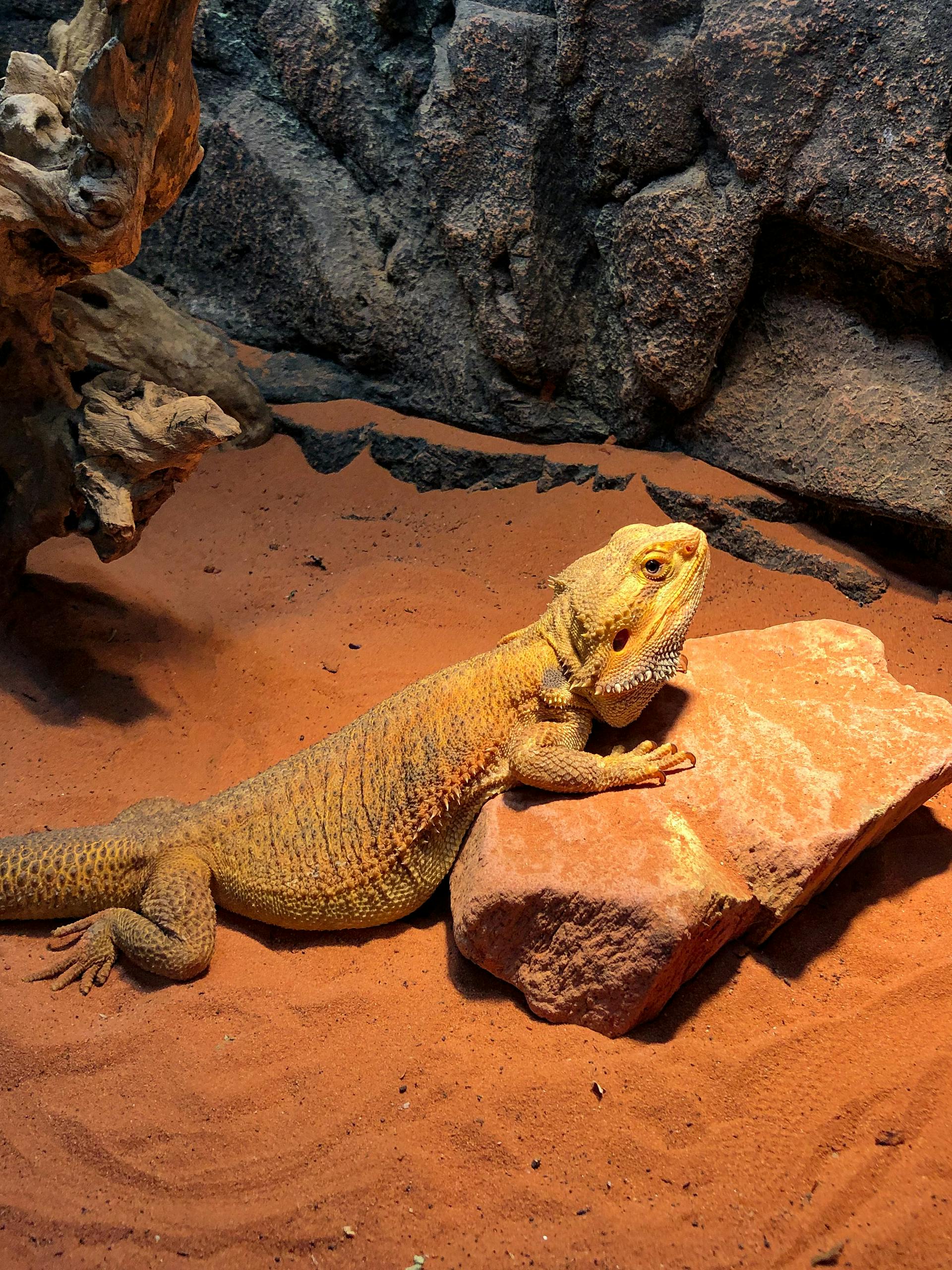
Bearded Dragon Heat and UVB: Which Mega-Ray Bulb, What Wattage, and How Far Away
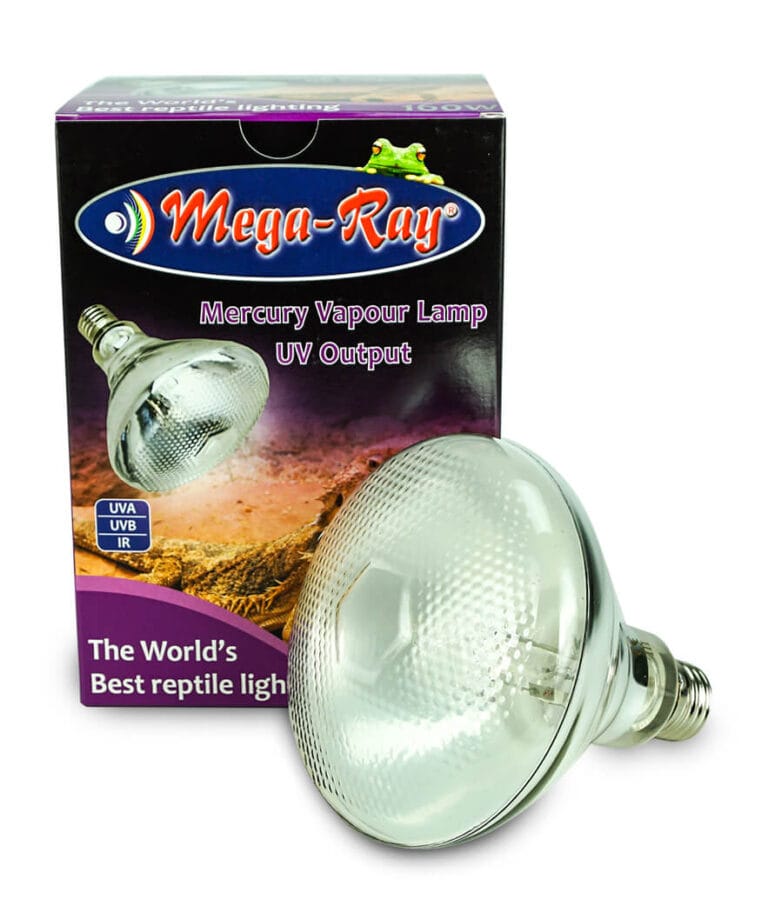
You have a bearded dragon, a tank that is probably a 40-gallon or a 4×2×2, and three different answers about which light to buy. Here is the one-lamp version. A Mega-Ray mercury vapor bulb gives your dragon the heat and the UVB from a single socket, and which one you need comes down to one measurement: how far the bulb will sit from your dragon’s back when it basks.
| Your enclosure | Bulb | Distance, bulb face to dragon’s back | Fixture |
|---|---|---|---|
| 40-gallon breeder, 36″ tanks, anything 16–20″ tall | Mega-Ray 100W | 14–16″ — on a lamp stand in a 16″-tall tank | Ceramic socket; a standard 150 W reptile dome is fine |
| 4×2×2, 120-gallon, anything 24″ or taller | Mega-Ray 160W | 20–22″ — a dome on the lid usually lands here | Ceramic socket rated above 160 W for PAR38 (e.g. the Bayco SL-302B3 brooder clamp light) — a 150 W clamp lamp is not |

Those distances are Mega-Ray’s published figures, not ours, and they come with the two rules that matter most: minimum is not optimum, and a screen top takes 20–40 % off whatever reaches the animal. Get the distance right and the rest of this page is just making sure it stays right for a year.
What getting it wrong costs
Too little UVB and a bearded dragon cannot make vitamin D3, so it cannot use the calcium in its food — that is metabolic bone disease, the soft jaw and trembling legs every reptile vet sees weekly, and it starts months before you notice. Too close a bulb is the opposite mistake: squinting, swollen eyes, a dragon that suddenly refuses its basking spot. And the quiet one: a 160 W bulb screwed into a 150 W clamp lamp, which is how sockets melt. Every one of those is avoided by choosing the wattage for your tank and mounting it at the distance in the table. That is the whole job.
Why “what watt?” has a real answer with this bulb
You may have read that wattage doesn’t matter for UVB. That advice is about fluorescent tubes, where wattage only describes length. A mercury vapor bulb is a different kind of lamp — one bulb producing heat, light, UVA and UVB together — and its wattage is its reach. The Mega-Ray 100 W does its best work at 14–16″; the 160 W at 20–22″. Same spectrum, different throw. So the question “what watt for my bearded dragon?” is exactly the right one, and the answer is whichever bulb’s sweet spot matches the height of your tank.
For the record, a bearded dragon’s targets are a basking surface of 100–110 °F, a cool end of 75–85 °F, and Ferguson Zone 3 UVB at the basking spot — a UV Index of roughly 3–6 on a meter (ReptiFiles aims for 4–4.5). A Mega-Ray at its optimum distance is built to hit that overlap of heat and UV in one place, which is the point of it.
The 100 W is the 40-gallon bulb — with one ten-dollar part
Official range: minimum 12″, optimum 14–16″, maximum 20″.
A 40-gallon breeder is only 16″ tall. Sit a dome straight on the screen lid and the bulb face is about 15″ above the floor; add a basking platform that lifts your dragon 2–4″ and it is now 11–13″ from the bulb — at or inside the minimum, not the optimum. The fix is a lamp stand, or a riser under the dome, so the bulb face sits 14–16″ from your dragon’s back. Ten dollars, five minutes, and the 100 W becomes exactly the right bulb for this tank. (Remember the screen between them takes 20–40 %; staying at the 14″ end of the range accounts for it.) In a 20″-tall enclosure the same arithmetic usually lands in the optimum with the dome on the lid.
The 160 W is the 4×2×2 bulb
Official range: minimum 18″, optimum 20–22″, maximum 24″.
A 4×2×2 is 24″ tall. Dome on the lid, bulb face at roughly 23″, a 2–3″ basking platform — and your dragon is at 20–21″, squarely in the optimum. No stand, no maths, no compromise: this is the cleanest fit in the whole line-up, and it is why the 160 W is the bulb we point most 4×2×2 owners to.
One rule comes with it. The 160 W needs a ceramic fixture rated above 160 W for a PAR38 bulb — the Bayco SL-302B3 10½″ brooder clamp light (porcelain socket, 200 W PAR38 rating, hardware and farm-supply stores) is a proven one. The popular 150 W reptile clamp lamps are not rated for it, and a 150 W socket under a 160 W bulb is the single most common cause of melted sockets and early bulb failure. Check the rating stamped on your fixture before you order; if you are not sure what yours is, ask us — we will tell you.
Why a Mega-Ray
- One bulb does the whole job. Heat, visible light, UVA and UVB from a single self-ballasted PAR-38 — no external ballast, no second fixture to buy or track.
- You are never guessing the distance. Mega-Ray publishes a minimum, optimum and maximum for every wattage. That table at the top is theirs, and it is the reason we can tell you “14–16″” instead of “it depends”.
- Made in Germany, shipped from Mega-Ray’s US distributor. Every order ships from the distributor’s own stock, free in the US, and is covered by a 6-month warranty.
- Independently tested. UV Guide UK measured a self-ballasted Mega-Ray at −15% UVB after a year and −17% after 18 months of daily use, where other mercury vapor lamps in the same test series lost 60–70% in their first 100 hours; no UVC, and the glass blocks everything below 295 nm (F. Baines, 2006 and 2014). See the full test results.
- Rated for every Ferguson zone. In the BIAZA UV-Tool (Baines et al., Journal of Zoo and Aquarium Research, 2016), a peer-reviewed assessment of 24 reptile lamps co-authored by five UK zoos, the Mega-Ray 100W and 160W are ticked for all four Ferguson zones — bearded dragons are Zone 3. Only five lamps in the table reach Zone 4.
- A person will answer. Tell us your species, your tank height and whether there is a screen in the way, and we will give you the wattage and the distance. We would rather send the right bulb than the bigger one.
Set it up once, correctly
Measure from the face of the bulb to the highest point your dragon’s back reaches on the platform — not to the floor. Decor shortens that distance; a lamp stand lengthens it. Hang the bulb vertically, pointing straight down over the basking spot, not over the middle of the tank; it is a beam, and the beam has to land where the dragon sits.

If there is a screen between bulb and animal, it takes 20–40 % of the output. Either stay at the near end of the optimum (14″ for the 100 W, 20″ for the 160 W), cut the mesh under the fixture so the bulb sees the animal, or mount inside the enclosure on a guarded ceramic fixture if the height allows. Do not “make up for” a screen by going under the minimum — that trades a small UV loss for a burn risk.
Then check the heat. After an hour, read the basking surface with an infrared thermometer. Over 110 °F: raise the fixture within the range, or lower the platform. Under 100 °F at the correct distance — rare in a 40-gallon or 4×2×2, more likely in a draughty room — add a plain flood lamp for heat rather than moving the Mega-Ray closer. A mercury vapor bulb cannot be dimmed or run on a thermostat, so distance and wattage are your controls, and the order is always UVB distance first, heat second.
Get the full year out of it
A Mega-Ray is rated for 6–12 months of UVB. These habits get you to the long end:
- Ceramic socket, rated above the bulb. 150 W fixture for the 100 W; above 160 W for PAR38 (e.g. the Bayco SL-302B3) for the 160 W. Plastic sockets and under-rated fixtures are the reason most “bad bulb” stories exist.
- Straight down, never angled. Horizontal or tilted mounting shortens the life of any mercury vapor bulb.
- On a plain timer, never a dimmer or dimming thermostat. 12–14 hours in summer, 10–12 in winter.
- Let it restrike on its own. If it goes out, it will not relight until it cools — normal for the technology.
- Keep water off it. A mister hitting a hot bulb can crack it.
- Write the install date on the base, and if you own a Solarmeter 6.5, read the basking spot when the bulb is new and again at six months. Replace when it drops below Zone 3, whatever the calendar says.
The two Mega-Rays that are not for bearded dragons
The 70 W (optimum 8–10″) is the shade-dweller bulb — leopard geckos, crested geckos, corn snakes. Over a bearded dragon it would sit too close to make a proper basking spot and would not deliver Zone 3 at a sensible height. The 275 W (optimum 36–42″) is a professional bulb for zoo enclosures and very tall builds; in a home tank it would be far inside its minimum. We will not sell you either for a bearded dragon.
Frequently asked questions
How many watts should my UVB light be for a bearded dragon? With a Mega-Ray, choose by distance: 100 W at 14–16″ for 40-gallon-class tanks (on a lamp stand), 160 W at 20–22″ for 4×2×2s and taller.
Is 100 W too much for a bearded dragon? Not at the right distance. A Mega-Ray 100 W at 14–16″ is the specification for a 40-gallon breeder. It is too much under 12″, and too little for UVB over 20″.
Which Mega-Ray bulb for a 4×2×2? The 160 W at 20–22″, in a ceramic fixture rated above 160 W for PAR38 bulbs, such as the Bayco SL-302B3 brooder clamp light.
How far should a UVB bulb be from a bearded dragon? For the Mega-Ray 100 W, 14–16″ from the bulb face to the dragon’s back (range 12–20″). For the 160 W, 20–22″ (range 18–24″). Add a lamp stand if your tank puts it closer.
Can a bearded dragon get too much UVB? Yes — any UVB source mounted under its minimum distance can cause eye irritation, squinting and skin damage. If your dragon suddenly avoids the basking spot or keeps its eyes closed under the lamp, raise the bulb and re-check the distance.
Do I still need a separate heat lamp with a Mega-Ray? Usually not. At the correct distance a Mega-Ray makes a 100–110 °F basking surface in most 40-gallons and 4×2×2s. Measure; if the surface is cool at the correct UVB distance, add a plain flood for heat rather than moving the Mega-Ray closer.
Do bearded dragons need a light at night? No. Darkness every night. If the room falls below about 65 °F, use a ceramic heat emitter on a thermostat — it makes heat, not light.
How often do I replace it? Every 6–12 months, or sooner if a UV meter shows the basking spot has fallen below Zone 3.
Choosing yours
- 40-gallon / 36″ tank / 16–20″ tall → Mega-Ray 100 W mercury vapor bulb, on a lamp stand, 14–16″ from your dragon’s back.
- 4×2×2 / 120-gallon / 24″+ tall → Mega-Ray 160 W mercury vapor bulb, 20–22″, in a ceramic fixture rated above 160 W for PAR38 (the Bayco SL-302B3 or similar).
- Something in between, or a screen in the way? Tell us the tank and the species and we will give you the bulb and the distance. The full species chart is on our Which Mega-Ray bulb? guide.
$48.95, made in Germany, free US shipping, 6-month warranty.
Sources
- Mega-Ray Pet Care Lighting, official distance and species guidance letter (distances, screen deflection, fixture requirements). Reproduced on our species guide.
- Baines, F. et al. (2016). “How much UV-B does my reptile need? The UV-Tool, a guide to the selection of UV lighting for reptiles and amphibians in captivity.” Journal of Zoo and Aquarium Research 4(1): 42–63. (Ferguson Zones; bearded dragon = Zone 3.)
- ReptiFiles, Bearded Dragon Lighting, Heating & Humidity Requirements (basking 100–110 °F; UVI 4–4.5 at the basking spot).
Already have a Mega-Ray?
We'll email you once when it's due for replacement, 11 months after you fitted it. One email, nothing else.