Tortoise UVB and Heat Lamp: Which Mega-Ray Bulb, and How Far Above the Shell
A tortoise basks for two reasons. It warms up enough to digest its food and move about, and, under the sun, it makes the vitamin D3 that lets it use the calcium in its diet for shell and bone. Indoors, both have to come from the lamp over the basking spot. A Mega-Ray mercury vapor bulb gives the heat and the UVB from one socket, which suits a tortoise table well: one fixture over one basking spot, and the rest of the table left cooler.
Which Mega-Ray you need comes down to two things: what kind of tortoise you keep, and how far the bulb will hang above the top of its shell.
| Tortoise | Sun exposure (BIAZA UV-Tool) | Mega-Ray | Bulb face to the top of the shell |
|---|---|---|---|
| Red-footed | Zone 1–2: partial sun, plenty of shade | 70W, or 100W in a taller setup | 70W: 8–10″ · 100W: 14–16″ |
| Russian (Horsfield’s), Hermann’s, Greek | Zone 3: open or partial sun | 100W, or 160W hung higher | 100W: 14–16″ · 160W: 20–22″ |
| Leopard | Zone 3 | 100W for juveniles, 160W for adults | 100W: 14–16″ · 160W: 20–22″ |
| Sulcata | Zone 3–4: open to mid-day sun | 100W for juveniles, 160W for adults | 100W: 14–16″ · 160W: 20–22″ |
| Any, in a barn, greenhouse or tall indoor pen | — | 275W, only if it can hang 36–42″ above the shell | 275W: 36–42″, never under 30″ |
Measure first. The rest of this guide explains the numbers and how to set the lamp up so it keeps working for a year.
Measure to the top of the shell
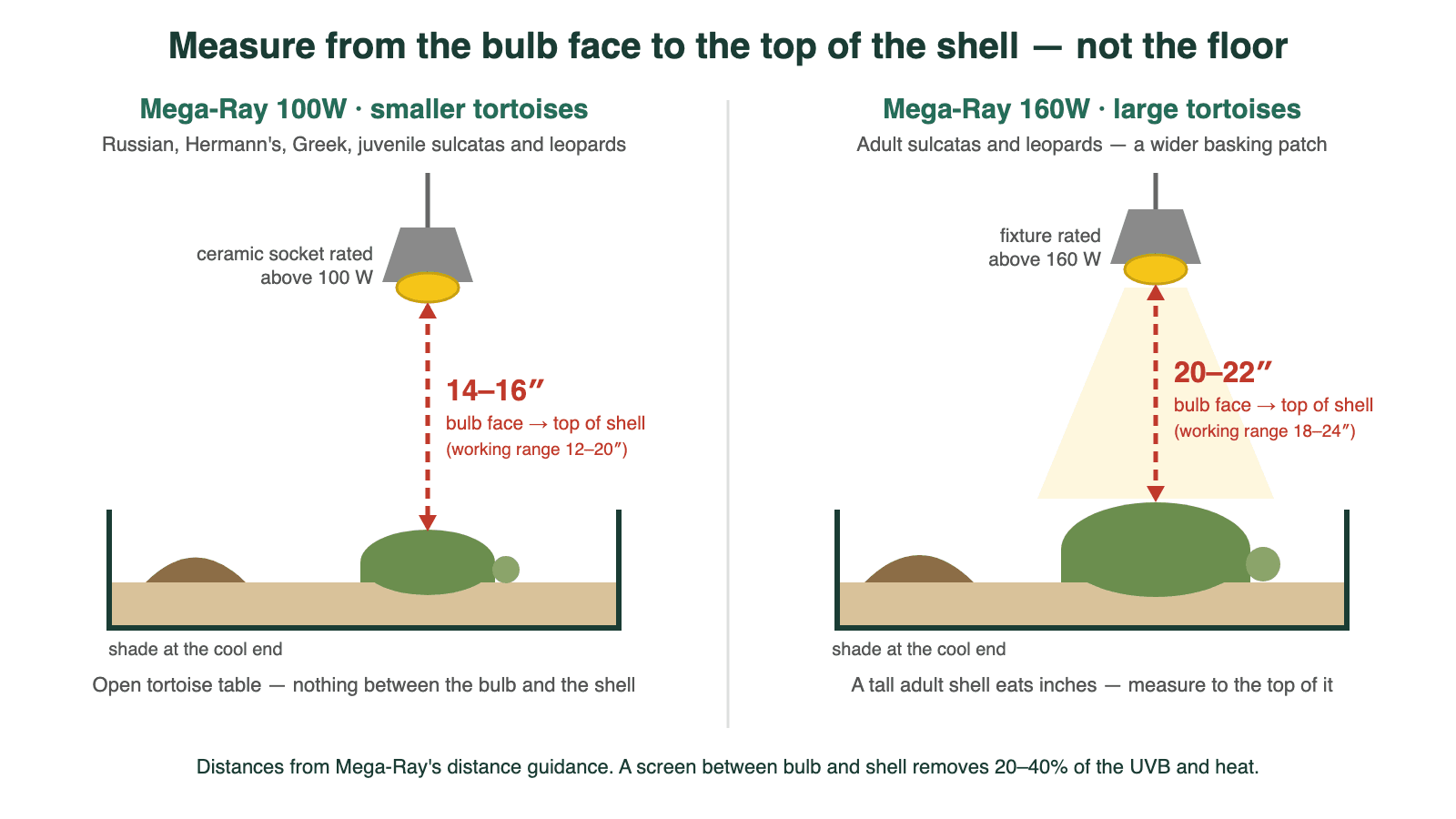
Measure with the tortoise on its basking spot, from the face of the bulb (the glass, not the socket) to the highest point of the shell. Tortoises are tall animals. A young Russian’s shell adds an inch or two above the substrate; an adult sulcata’s adds several, which is often the difference between the 100W’s range and the 160W’s.
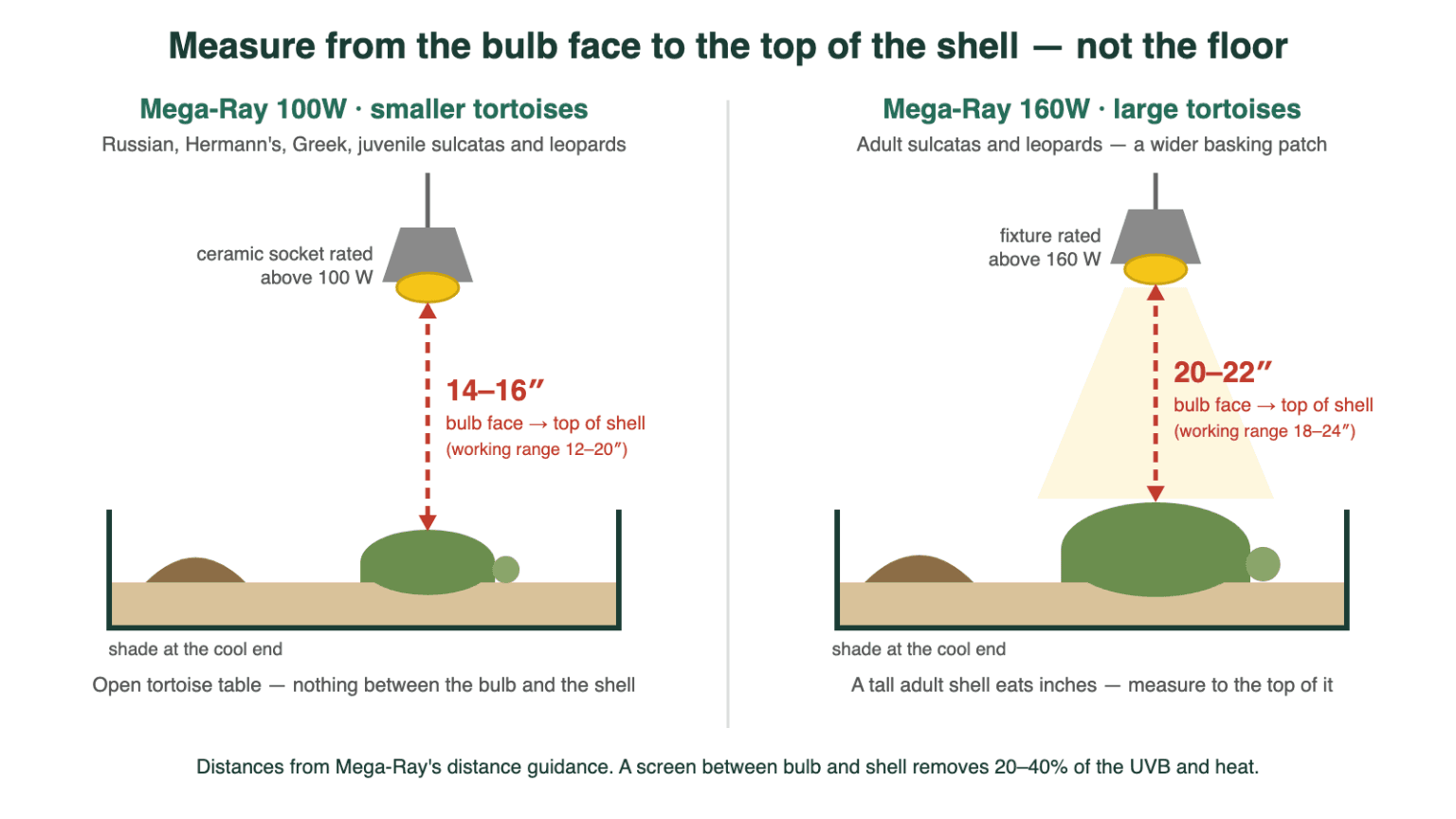
Mega-Ray gives each bulb a working range and an optimum:
| Bulb | Too close — raise the lamp | Working range | Optimum |
|---|---|---|---|
| 70W | under 6″ | 6–12″ | 8–10″ |
| 100W | under 12″ | 12–20″ | 14–16″ |
| 160W | under 18″ | 18–24″ | 20–22″ |
| 275W | under 30″ | 30–48″ | 36–42″ |
Aim for the optimum. The minimum is a hard floor, not a suggestion. Beyond the maximum, the bulb is lighting the room rather than the tortoise. If your setup puts the bulb outside the range, move the lamp; don’t swap to a smaller bulb to make a short distance work.
What your tortoise needs from the basking spot
The BIAZA UV-Tool (Baines et al., Journal of Zoo and Aquarium Research, 2016) is the reference UK zoos use to plan reptile lighting. It sorts species into four Ferguson zones by how much sun they seek, and gives a UV index range for each: zone 2 averages about UVI 0.7–1.0, zone 3 about 1.0–2.6 with a maximum of 2.9–7.4 at the hottest point, and zone 4 about 2.6–3.5 with a maximum of 4.5–9.5. Its species table gives each tortoise’s basking-zone surface temperature and a typical captive day length:
| Tortoise | Ferguson zone | Basking-zone surface temperature | Day length (summer) |
|---|---|---|---|
| Sulcata (African spurred) | 3–4 | 45–50 °C (113–122 °F) | 13 hours |
| Leopard | 3 | 40–50 °C (104–122 °F) | 14 hours |
| Russian (Horsfield’s) | 3 | 35 °C (95 °F) | 14 hours |
| Hermann’s | 3 | 35 °C (95 °F) | 14 hours |
| Greek (spur-thighed) | 3 | 35 °C (95 °F) | 14 hours |
| Red-footed | 1–2 | 30–35 °C (86–95 °F) | 13 hours |
The same paper’s lamp table rates the Mega-Ray 100W and 160W as able to provide all four zones, depending on how far away they hang. Those temperatures are measured on the basking surface, so check yours with a surface (infrared) thermometer pointed at the spot, not with a thermometer on the wall.
Why a bigger tortoise gets the bigger bulb
The UV-Tool asks for a basking zone “at least as large as the whole body of the animal”. A mercury vapor bulb throws a cone of light, and the farther it hangs, the wider the pool it lights. A 160W at 20–22″ lights a wider patch than a 100W at 14–16″, wide enough for an adult sulcata or leopard to get its whole shell into it. A Russian or Hermann’s fits comfortably under a 100W.
If one bulb still can’t cover a very large tortoise, the paper notes that “multiple lamps may be required in some cases”, with a caution: the effects are additive, so overlapping beams must be used with care. Keep two bulbs far enough apart that their pools don’t stack into one hotter, stronger spot, and measure both.
The paper is equally clear about the other end of the table: “provision of shade is vital for all species, regardless of their Ferguson zone.” Put the lamp over one end and a hide at the other, so your tortoise can choose.
Heat: set it with height and wattage, not a dial
A mercury vapor bulb runs at full power on a plain timer. It can’t be dimmed or run on a thermostat, and a dimmer or pulse-proportional thermostat will destroy it. That leaves two controls: which wattage you buy, and where the bulb hangs inside its working range.
- Hang the bulb at the optimum distance for your wattage.
- After it has been on for an hour, measure the basking surface.
- Too hot: raise the lamp toward the far end of its range.
- Short of your species’ figure: add heat beside it rather than lowering the bulb below its minimum. Mega-Ray’s own guidance is to “always consider more distance and additional heat, as needed”. Sulcatas and leopards, with the highest basking figures in the table, are the tortoises most likely to need that.
Tables, closed chambers and big indoor pens
Open tortoise tables are the easy case: nothing sits between the bulb and the shell. Hang the fixture from above or from a stand over one end of the table.
Screens and lids cost you. Mega-Ray’s guidance is that a screen removes 20–40% of the light, heat and UVB passing through it, so with a mesh top, stay at the near end of the working range. Glass or clear plastic is worse: the UV-Tool notes that ordinary glass and plastics must not be placed between the lamp and the animal, because they block transmission of UVB.
Closed chambers, often used for red-footed tortoises and hatchlings that need humidity, keep heat in as well as moisture, and a mercury vapor bulb heats as well as lights. Mega-Ray’s letter asks for “proper humidity and airflow” alongside its bulbs. Put the bulb over a ventilated section, keep the far end genuinely cool, and check the temperature at both ends once the lamp has been on for a few hours.
Barns, greenhouses and tall indoor pens for adult sulcatas are the one place the 275W belongs. It needs 36–42″ between the bulb face and the top of the shell and never less than 30″, so it is too strong for a tortoise table.
The fixture rule
Every Mega-Ray needs a ceramic or porcelain socket rated above the bulb’s own wattage. Mega-Ray asks for a fixture rated for more wattage and voltage than the bulb.
- 70W and 100W: a standard ceramic-socket clamp lamp or dome rated to 150 W.
- 160W: a fixture rated above 160 W. Most reptile clamp lamps stop at 150 W, so check the rating; the 160W page names one that qualifies.
- 275W: a porcelain keyless lampholder rated around 660 W in a metal reflector, as on the 275W page.
Running it
- On a plain timer. Match the day lengths in the table: about 13 hours for sulcata and red-footed tortoises, and 14 hours in summer for leopard, Russian, Hermann’s and Greek tortoises.
- Replace every 6–12 months. UV Guide UK measured a self-ballasted Mega-Ray at −15% UVB after a year and −17% after 18 months of daily use. Output still falls steadily, and a bulb can fail without warning. If you own a UV meter, replace it when your readings say so.
Why a Mega-Ray
- Heat and UVB from one socket: one fixture over the basking spot, which is how a tortoise table is laid out anyway.
- Independently tested. UV Guide UK measured a self-ballasted Mega-Ray at −15% UVB after a year and −17% after 18 months, where other mercury vapor lamps in the same test series lost 60–70% in their first 100 hours (2006 report). A 2014 re-test found no UVC and glass that blocks everything below 295 nm.
- Rated for every sun zone. The UV-Tool rates the 100W and 160W for all four Ferguson zones, one of five lamps in its table to do so. See every measurement.
- Made in Germany, shipped from Mega-Ray’s US distributor, with free US shipping and a 6-month warranty.
Common questions
What wattage bulb does a sulcata tortoise need?
A Mega-Ray 100W while it is small, and a 160W once it is an adult, so the basking patch is big enough for the whole shell: 14–16″ from the bulb face to the top of the shell for the 100W, 20–22″ for the 160W. Adults living in a barn or a tall indoor pen can use the 275W at 36–42″.
How far should a heat lamp be from a tortoise?
For a Mega-Ray, it depends on the wattage: 8–10″ for the 70W, 14–16″ for the 100W, 20–22″ for the 160W and 36–42″ for the 275W, always measured from the bulb face to the top of the shell. Never go under 6″, 12″, 18″ or 30″ respectively.
Can a tortoise get too much UVB?
Yes, which is why the minimum distances are hard floors and why shade matters. The UV-Tool asks for shade for every species, whatever its zone, and warns that overlapping beams add together. A tortoise that won’t use the basking spot, or keeps its eyes closed under the lamp, is telling you the bulb is too close.
Can I put a mercury vapor bulb on a thermostat?
No. A Mega-Ray runs at full power on a plain timer, and a dimmer or pulse-proportional thermostat will destroy it. Control the temperature with the lamp’s height and the wattage you choose, and add a separate heat source if you need more.
Does a Russian tortoise need a 160W?
Usually not. The UV-Tool puts Russians in zone 3, which the 100W can provide at 14–16″, and a Russian is small enough to fit inside that basking patch. Choose the 160W only if your lamp will hang 18–24″ above the shell.
How often should I replace the bulb?
Every 6–12 months. It will look as bright as the day you fitted it long after its UVB has fallen, so go by the calendar or a UV meter, not by eye.
Choosing yours
- Red-footed tortoise: the Mega-Ray 70W at 8–10″, or the 100W at 14–16″ in a taller setup, with a well-ventilated chamber and a cool end.
- Russian, Hermann’s, Greek, or a young sulcata or leopard: the Mega-Ray 100W at 14–16″.
- Adult sulcata or leopard: the Mega-Ray 160W at 20–22″, in a fixture rated above 160 W.
- Barn, greenhouse or tall indoor pen: the Mega-Ray 275W at 36–42″.
Still not sure? Our species guide covers every animal Mega-Ray lists, how mercury vapor bulbs work explains the bulb itself, or email us your tortoise, its shell height and your setup.
Sources
- Baines F., Chattell J., Dale J., Garrick D., Gill I., Goetz M., Skelton T., Swatman M. (2016). How much UV-B does my reptile need? The UV-Tool, a guide to the selection of UV lighting for reptiles and amphibians in captivity. Journal of Zoo and Aquarium Research 4(1): 42–63 — https://www.jzar.org/jzar/article/view/150. Table 1 (Ferguson zone UVI ranges); Appendix species entries (Centrochelys sulcata: zone 3–4, basking surface 45–50 °C, 13:11; Geochelone pardalis: zone 3, 40–50 °C, 14:10; Agrionemys horsfieldii: zone 3, 35 °C, 14:10; Testudo hermanni: zone 3, 35 °C, 14:10; Testudo graeca: zone 3, 35 °C, 14:10; Geochelone carbonaria: zone 1–2, 30–35 °C, 13:11); text on basking-zone size, multiple lamps, shade and glass/plastics; Table 2 (Mega-Ray 100W and 160W rated for all four zones).
- Mega-Ray Pet Care Lighting, official distance and species guidance letter (minimum, maximum and optimum distances for all four bulbs; screens deflect 20–40%; ceramic fixture rated above the bulb’s wattage; “always consider more distance and additional heat, as needed, along with proper humidity and airflow”; red-footed tortoises in the partial-sun 70–100W group). Reproduced on our species guide.
- UV Guide UK (2006). ReptileUV Mega-Ray Mercury Vapour Lamps for Reptiles — Test Report (archived copy): a self-ballasted lamp at −15% UVB after 12 months and −17% after 18 months; other mercury vapour brands in the same series −60–70% in their first 100 hours.
- UV Guide UK (2014). Mega-Ray 100W and 160W test results (reproduced on ourreptileforum): no UVC; glass blocks below 295 nm.
Already have a Mega-Ray?
We'll email you once when it's due for replacement, 11 months after you fitted it. One email, nothing else.