Turtle UVB and Heat: Which Mega-Ray Bulb for the Basking Dock, and How Far Above It
A red-eared slider spends its day doing two things: swimming, and hauling out onto the dock to bask. The basking is not optional. That is where it warms up enough to digest, and where it makes the vitamin D3 that lets it use the calcium in its food — the difference between a hard, smooth shell and a soft, deformed one. Water blocks UVB, so everything that matters about lighting happens in the few inches between the bulb and the turtle’s shell on the dock.
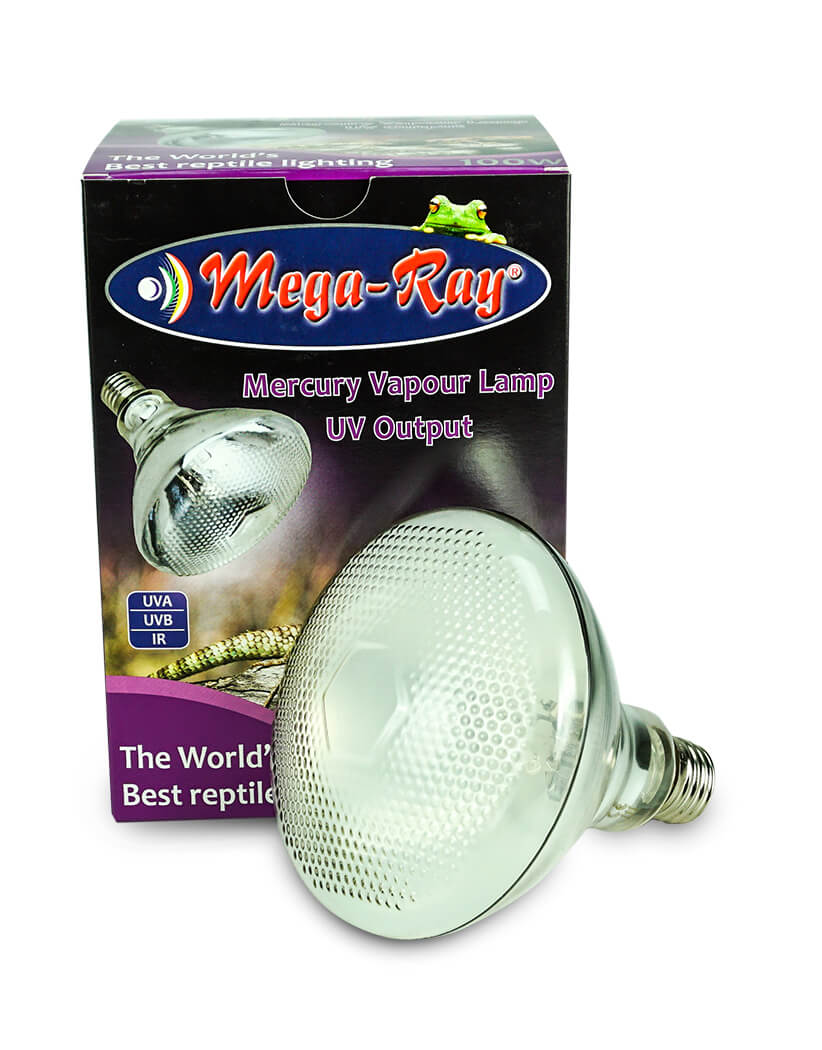
A Mega-Ray mercury vapor bulb puts the heat and the UVB in that one spot from a single socket. Which one you need comes down to one measurement: how far the bulb will sit above the top of your turtle’s shell when it is on the dock.
| Bulb face to the top of the shell (turtle on the dock) | Bulb | Typical setup |
|---|---|---|
| 12–20″ (optimum 14–16″) | Mega-Ray 100W mercury vapor bulb | Dock a few inches above the water, bulb in a dome on a lamp stand over the open tank — most 40- to 75-gallon turtle tanks |
| 18–24″ (optimum 20–22″) | Mega-Ray 160W mercury vapor bulb | Tall tanks, low docks, or a stand that puts the bulb well above the rim — 120-gallon and stock-tank setups |

Measure it. If the number lands in the 100W range, buy the 100W; if it lands in the 160W range, buy the 160W. If it lands under 12″, don’t buy a smaller bulb — raise the lamp. The rest of this guide is why, and how to set it up so it keeps working for a year.
Why the dock is the only place that counts
Turtles don’t get UVB through water in any useful amount, and they don’t get heat from a bulb while they’re swimming. Your submersible heater handles the water. The bulb’s whole job is the dock: a basking surface warm enough that the turtle wants to stay, and a UVB level high enough to do something while it’s there.
The BIAZA UV-Tool — a peer-reviewed species database built by UK zoo vets and keepers (Baines et al., JZAR, 2016) — lists the red-eared slider as a Ferguson zone 3–4 basker with a basking temperature of 35 °C (95 °F). Zone 3–4 is the open-sun category, the same one bearded dragons sit in. In plain terms: this is an animal that expects a real patch of sun, not a hint of one. Zone 3 means a UV index of roughly 1–2.6 across the basking zone, rising to the high single digits at the hottest point; zone 4 runs a little higher still.
That is what a mercury vapor bulb is for. Mega-Ray’s own figures put the 100W and 160W at roughly 150–200 µW/cm² of UVB at their minimum distance and 50–70 µW/cm² at their maximum — a gradient from “full sun at the top of the dock” to “still useful at the edge”. The UV-Tool’s lamp table rates both bulbs as able to provide every one of the four zones at the right distance.
What getting it wrong costs
Too little UVB and the turtle can’t make D3; without D3 it can’t absorb calcium; without calcium the shell and bones soften. In sliders that shows up as a shell that gives under finger pressure, pyramiding or a lumpy, uneven carapace, a beak that overgrows, and eventually the lethargy and weakness of metabolic bone disease. It builds over months and much of it doesn’t reverse.
Too much, too close, is the other failure: a bulb mounted under its minimum distance can irritate the eyes and burn the skin and shell. Turtles that suddenly stop basking, or bask with their eyes shut, are telling you the lamp is too close.
Both problems have the same fix — the right bulb at the right distance — which is why the measurement comes first.
Measure from the bulb face to the shell, not to the water
Put the dock where it will actually live. Put your turtle on it, or a book the height of its shell. Now measure from the glass face of the bulb to the top of the shell. That number, not the tank height and not the water line, picks the bulb.
Two things change the number:
- A screen lid takes 20–40% of the UVB and heat away (Mega-Ray’s own figure). If the bulb sits on a screen, treat the distance as a step further away — or, better, mount the bulb over an open section. Most turtle tanks run open on top anyway for the heat to escape.
- Docks move. Floating docks rise and fall with the water level; a turtle that grows from 4″ to 8″ ends up 2″ closer to the bulb. Re-measure when you change the water level and every few months as the animal grows.
The 100W is the bulb for most turtle tanks
Most home slider setups — a 40-gallon breeder, a 55, a 75 — are 16–21″ tall, with the dock riding a few inches above the water line. A dome sitting on the rim puts the bulb face 8–12″ from the shell, which is too close for the 100W. Raise the dome on a lamp stand so the bulb face is 14–16″ above the shell and the 100W is exactly right: a 95 °F dock surface with UVB to match.
Check it with two cheap tools. An infrared thermometer on the dock surface after an hour should read in the 90s °F; adjust the stand height an inch at a time. If you own a Solarmeter 6.5, you want a UV index in the zone-3 range at the shell, roughly 2–4 directly under the bulb, tapering off across the dock.
The 160W is for tall tanks and low docks
If your dock sits deep in a tall tank — a 120-gallon at 24″, a stock tank with a sunken platform, or any setup where the bulb is going to end up 18–24″ from the shell — the 100W will run out of both heat and UVB before it gets there. That is the 160W’s range, and at 20–22″ it does for a big tank what the 100W does for a small one.
Two rules that come with the 160W: the fixture must be a ceramic socket rated above 160 W (Mega-Ray says 250 W+; the common 150 W clamp lamp is not enough and is the usual cause of a melted socket), and it must never be mounted closer than 18″ — a bigger bulb is not a substitute for raising a smaller one.
Why a Mega-Ray
- Heat and UVB from one socket. One bulb, one fixture, one spot on the dock that does both jobs — which is also one fewer thing to get wrong.
- Independently tested. UV Guide UK measured a self-ballasted Mega-Ray at −15% UVB after a year and −17% after 18 months of daily use (F. Baines, 2006), where other mercury vapor lamps in the same test series lost 60–70% in their first 100 hours. See the full test results.
- Rated for every Ferguson zone. The 100W and 160W are among the lamps in the JZAR UV-Tool rated for all four zones — zone 3–4 is what a slider needs.
- Made in Germany, shipped free in the US, with a 6-month warranty.
Water, fixtures and the things that end a bulb early
A turtle tank is a hard place for any hot lamp. Five rules keep a Mega-Ray working for its full year:
- Keep water off the glass. A splash on a hot bulb can crack it. Mount the bulb over the dock, not over open water, high enough that a diving turtle can’t reach it, and don’t mist or top up the tank with the lamp on.
- Ceramic socket, correct rating. Mega-Ray: “All of our bulbs require a ceramic base and require a higher amount of wattage and voltage than the bulb you need.” 150 W-rated domes suit the 100W; the 160W needs 250 W+.
- No dimmers, no dimming thermostats. A self-ballasted mercury vapor bulb is on/off only. Control the dock temperature with distance and a timer, never by dimming.
- Airflow. Give the dome room to shed heat. Don’t box it into a hood.
- Lights off at night. 12–13 hours on, then dark. The turtle’s heat at night comes from the water heater, not the bulb.
Get the full year out of it
UVB output falls long before the light looks any different. Budget a new bulb every 6–12 months — Mega-Ray’s measured decay is slow, which is the point of buying one, but “slow” is not “none”. A Solarmeter reading at the shell is the only way to know for sure; without one, 12 months is the outside limit. Write the install date on the dome.
Keeping a tortoise instead? Read the tortoise UVB and heat guide → — which Mega-Ray suits each species and how far above the shell to hang it.
Common questions
Do turtles really need UVB if they eat pellets with vitamin D3?
Yes. The UV-Tool lists red-eared sliders as zone 3–4 baskers — among the highest UVB categories — and dietary D3 does not replace basking for a species built to make its own. Treat fortified food as a supplement, not a substitute.
100W or 160W?
Measure from the bulb face to the top of the shell on the dock. 12–20″ → 100W (aim for 14–16″); 18–24″ → 160W (aim for 20–22″). Under 12″ → raise the lamp, don’t buy a smaller bulb.
Can the bulb go over the water?
Over the dock only. Water on hot glass can crack any bulb, and a turtle in the water gets nothing from it anyway.
How far from the turtle is too far?
Past the maximum for the bulb (20″ for the 100W, 24″ for the 160W) the UVB drops below the useful range. Mount inside the range and remember a screen counts as extra distance.
Does this work for painted turtles, map turtles, yellow-bellied sliders?
The yellow-bellied slider is listed in the same zone 3–4 band. For other basking pond turtles, check the species’ Ferguson zone; if it is zone 3 or 4, the same distances apply. If you’re unsure, send us the species and the tank and we’ll tell you.
Do I leave it on at night?
No. Darkness at night; the water heater keeps the turtle warm.
Not sure which one fits your tank? Tell us the species, the tank size and the bulb-to-shell distance and we’ll confirm the wattage — usually the same day.
Sources
- Baines, F. et al. (2016). How much UV-B does my reptile need? The UV-Tool, a guide to the selection of UV lighting for reptiles and amphibians in captivity. Journal of Zoo and Aquarium Research 4(1): 42–63 — Ferguson zones (Table 1), species database (red-eared and yellow-bellied slider: zone 3–4, basking 35 °C), lamp assessment (Table 2).
- Mega-Ray distance specifications and species categories (the US distributor’s letter; reproduced in Which Mega-Ray UVB bulb does your reptile need?).
- Baines, F. (2006). Mega-Ray narrow-flood lamp test report, UV Guide UK — decay measurements, summarized with source links on our test-results page.
Already have a Mega-Ray?
We'll email you once when it's due for replacement, 11 months after you fitted it. One email, nothing else.